
Sewer Repair
Sewer Camera Inspection: What You'll See and Why It Matters
Why every sewer repair starts with a camera, and what each finding means.
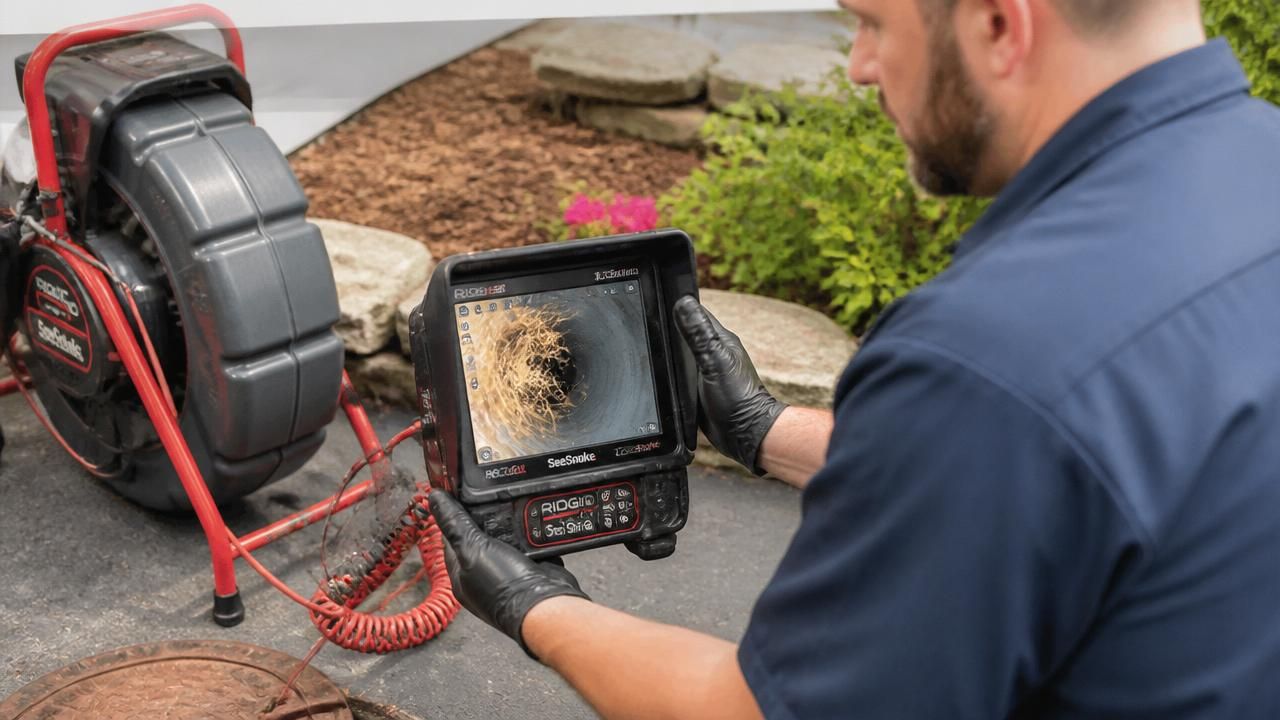
A sewer camera inspection sends a self-levelling camera head down the line on a flexible rod, from the cleanout toward the city main, while you watch the screen. It is the only way to know whether a line needs cleaning, a spot repair, or replacement: every one of those looks identical from the top of the cleanout.
What you will actually see
Sound pipe looks like an even tunnel with a thin film of water running along the bottom. The four things that are not that: roots hanging in from a joint, a belly where standing water fills the bottom of the frame and the camera swims, scale or grease narrowing the bore to a fraction of its diameter, and an offset or collapse where the tunnel simply stops being round.
The locator is half the value
The camera head carries a sonde, and a receiver above ground follows it. That means the fault is identified and marked on your driveway with a depth, which is the difference between a spot repair and digging a trench to find out. If someone shows you a fault on screen and cannot tell you where it is in the yard, the inspection is half done.
When it is worth doing before anything goes wrong
Two moments. Before buying a house, especially a pre-1980 one with mature trees, because the lateral is the single most expensive thing a standard home inspection does not look at. And before any work that will be paid for on top of the line (a driveway, a patio, a pool), since opening it later costs far more than confirming it now.
What it costs, honestly
We do not publish a figure, and any company that publishes one has not seen your line. What moves it is access (whether there is an existing cleanout or one has to be cut in), and length. The price is agreed in writing before the work starts, and if the inspection leads to a repair we will tell you what the footage does and does not prove.
Ask for the footage
Take the recording. It is the baseline for every future conversation about that line, it belongs to you, and if a second opinion is ever needed the next contractor should be reading the same evidence rather than starting again.
What the inspection cannot tell you
It shows the inside of the pipe, not the ground around it. A line can look sound on camera and still be sitting in soil that is washing out, and a hairline crack leaking only under load may not be visible at all. It is the best single diagnostic available for a lateral, and it is worth knowing its edges rather than treating clear footage as a warranty.