
Sewer Repair
Pipe Bursting vs. Pipe Lining: Which Trenchless Method Wins?
Diameter, slope, joints: the engineering choice between bursting and CIPP lining.
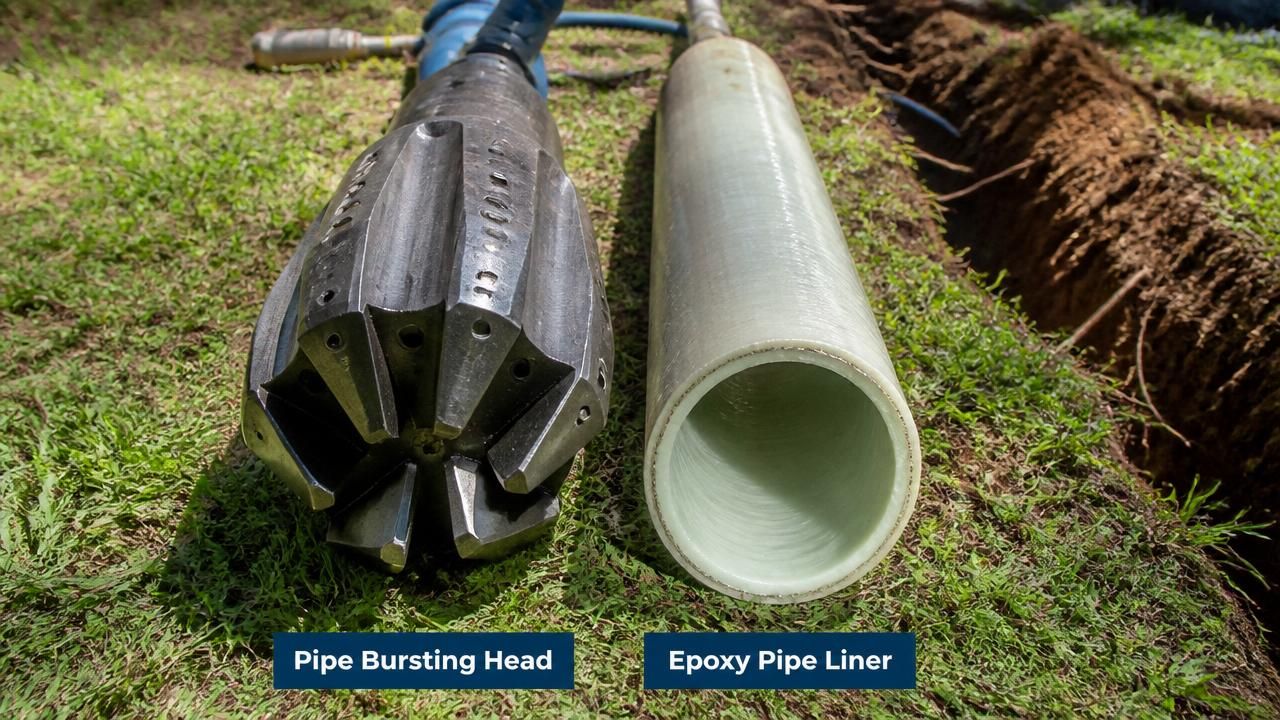
Both are trenchless, and they solve different problems. Lining cures a new resin pipe inside the existing one, so the host pipe has to be structurally there. Pipe bursting destroys the old pipe and pulls a new one through its path, so it works where the old line is collapsed, badly offset, or needs to come out bigger than it went in.
How lining works
A resin-saturated liner is pulled or inverted into the cleaned line and cured in place. The result is a jointless pipe inside the old one, which is the key point for root problems: joints are where roots enter, and a lined pipe no longer has any. It reduces the internal diameter slightly, which is almost never significant on a residential lateral.
How bursting works
A bursting head is pulled through the old line on a cable, splitting it outward into the surrounding soil while towing the new HDPE pipe in behind it. Because the old pipe is being destroyed rather than reused, its condition does not matter, and because the head displaces soil, the new line can be a size larger than the old one.
Which one your line needs
Lining suits a pipe with sound walls and bad joints: clay with root intrusion, cast iron with surface corrosion, a line that is otherwise straight. Bursting suits a pipe that has collapsed, has a significant offset the liner could not follow, has a belly that should be corrected, or is simply undersized. A camera and a locate answer this in one visit; nothing else does.
What both need that people forget
Access pits at each end. Trenchless does not mean no digging. It means digging two small pits instead of opening the whole run. Where the line passes under a driveway, mature landscaping or a patio, that difference is the whole point. Both also need the line cleaned first, because neither method works over roots and scale.
Permits and inspection
Sewer lateral work is permitted work in Orange County, and the city, or the County, for unincorporated areas like Ladera Ranch, North Tustin, Coto de Caza, Rossmoor and Rancho Mission Viejo: will want to inspect it. We pull the permit and we close it. An unpermitted lateral replacement is the kind of thing that surfaces at sale, years later, at the worst moment.
What happens to the branch connections
A house lateral usually has at least one branch tying in. Lining seals over those openings and they have to be reinstated afterwards by a cutter working from inside the pipe; bursting can shear a branch off entirely if it is not accounted for. Ask how the connections are being handled. It is the detail that separates a job done properly from one that produces a mystery blockage six months later.