
Water Heaters
Tankless vs Tank Water Heaters: Which Is Right for Orange County Homes?
We compare upfront cost, energy use, lifespan, and recovery time so you can pick the right water heater for your Orange County home.
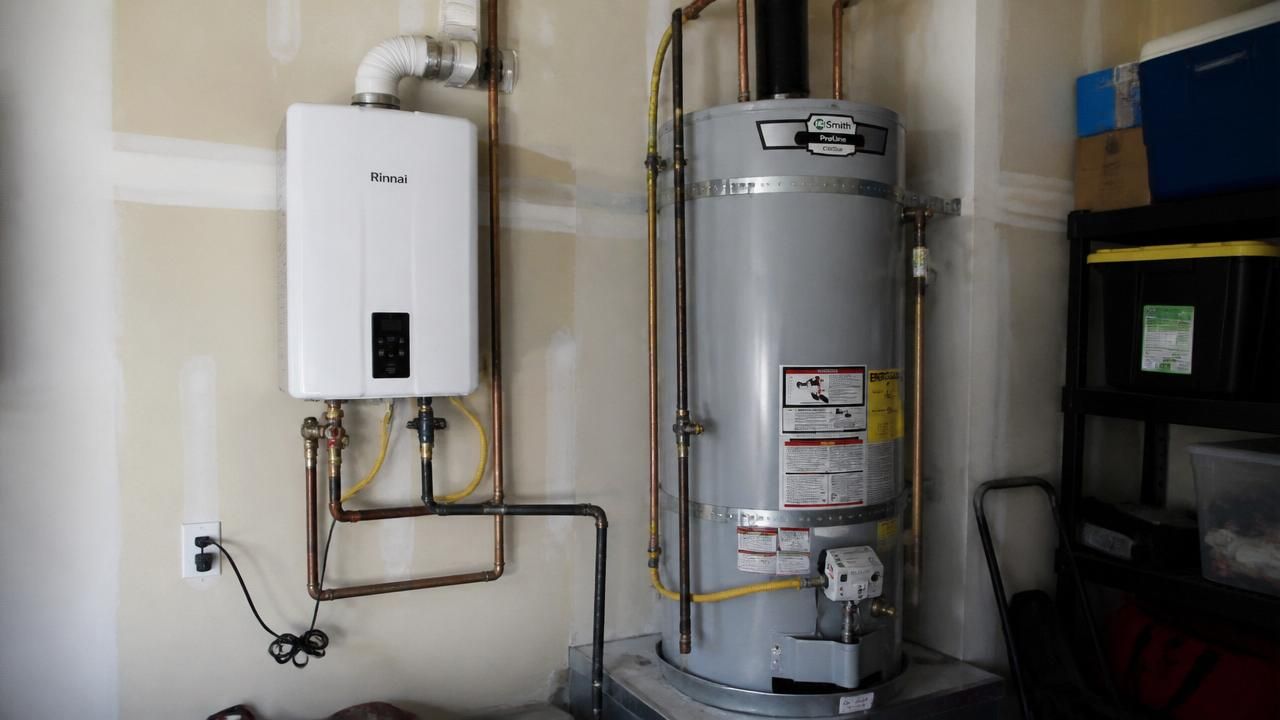
A tank keeps a reserve hot around the clock and refills after you use it. A tankless unit heats only while water is flowing and never runs out, but it can only heat so fast. That single difference decides which one suits a house: a tank fails you by running empty, a tankless fails you by running cold when too much is drawn at once.
What tankless is genuinely better at
Never running out, which matters for back-to-back showers or a large family on one bathroom. Floor space, since a wall unit frees the corner of the garage a 50 gallon tank occupies. Standby loss, because there is no reserve being kept hot at three in the morning for nobody. And service life: a well-maintained tankless commonly outlasts two tanks.
Where a tank still wins
Peak flow. A tank can deliver two showers and a dishwasher simultaneously because the hot water is already made; a tankless has to heat all of it in real time and may not have the capacity. Tanks are also cheaper to install, need no gas upsizing, and reuse the existing vent. If your household is modest and never runs out, a tankless solves a problem you do not have.
The two things that decide it in practice
The gas supply and the vent path. A tankless burner draws far more gas at peak than the tank it replaces, so the existing line is frequently too small or too long and has to be upsized. The venting has to be the manufacturer's own sealed system, terminated at set clearances; the old atmospheric flue cannot be reused. Together these two constrain the decision more often than preference does.
Hard water changes the maintenance answer
Orange County water is hard, and a tankless heat exchanger scales faster than most owners expect. Descaling roughly annually is realistic here, and it is only straightforward if isolation service valves were fitted at installation. A tank in the same water needs flushing but tolerates neglect longer. It just loses efficiency quietly instead of throwing an error code.
How we decide with you
We measure the peak-hour demand, the gas line size and length, and the vent route before recommending either. If the honest answer is a correctly sized tank, that is what we will say, and if it is tankless, that work has its own page. Either way the price is agreed in writing before anything starts.
Recirculation changes the comparison
If the complaint is waiting for hot water rather than running out, neither type fixes it on its own: that is distance from the heater to the tap. A recirculation loop or a demand pump addresses it, and both can be fitted to either kind of heater. Choosing tankless to solve a wait is a common and expensive mismatch.