
Emergency Plumbing
Galvanized Pipe Repair: Patch It or Replace the Whole System?
Pre-1970 Orange County homes still hide galvanized supply lines. Here's when a spot repair makes sense, and when it doesn't.
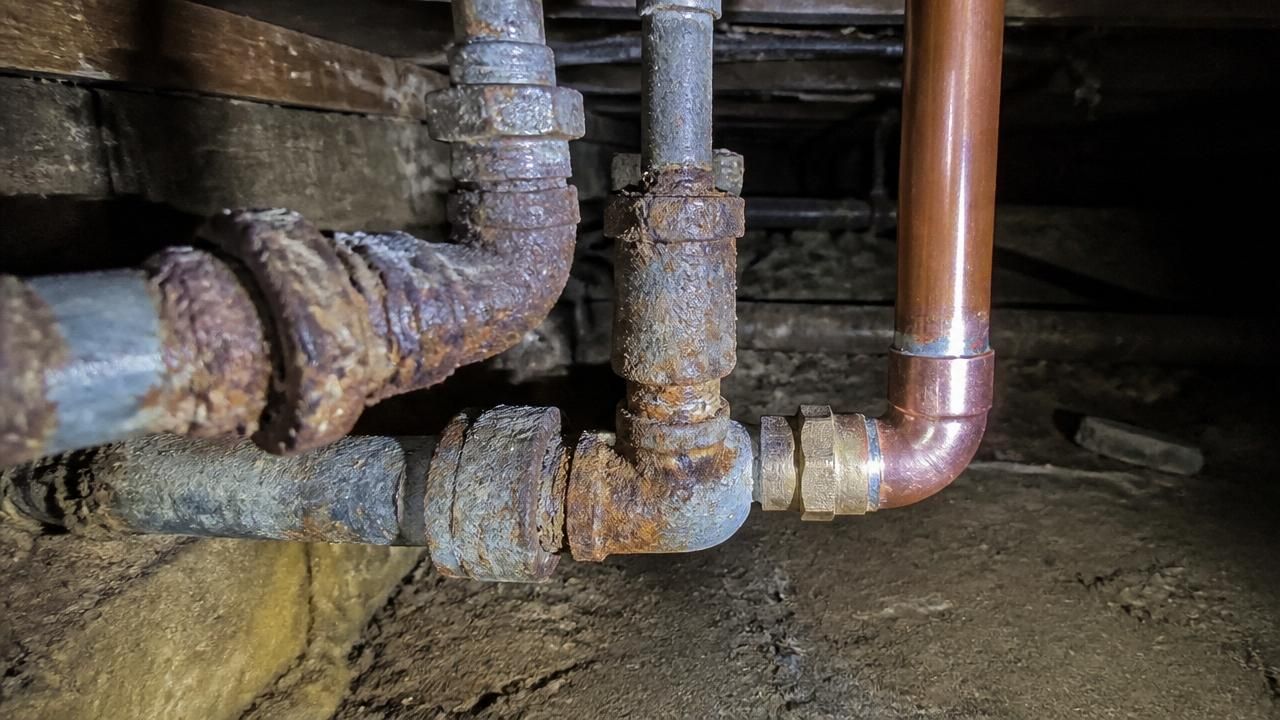
Replace it. Galvanized steel supply pipe corrodes from the inside along its entire length, so repairing one section leaves the next section as the new weakest point. The only question worth debating is whether to replace it all at once or in stages, and the answer usually depends on access rather than on the pipe.
What is happening inside
The zinc coating that protects the steel is consumed over decades. Once it is gone the steel rusts, and the rust builds inward as a rough scale that narrows the bore. A pipe that started at three quarters of an inch can be down to a pencil-width channel after sixty years, which is why pressure falls first at the fixtures furthest from the main.
The symptoms, in order of appearance
Weak pressure at the far bathroom. Rusty or brown water after the house has stood unused for a few days. Hot water worse than cold, because heat accelerates the corrosion. Then pinhole leaks, usually at threaded joints where the wall is thinnest.
Why patching disappoints
Cutting out a failed length and replacing it with copper or PEX solves that length. The adjacent galvanized is the same age, in the same water, with the same wall thickness, and connecting dissimilar metals directly introduces galvanic corrosion of its own unless a dielectric fitting is used. Both problems compound.
Staged replacement is legitimate
Doing the accessible runs first (a garage, a crawlspace, an attic), and leaving the buried or slab runs for later is a reasonable way to spread the work, provided everyone understands it is a repipe on an instalment plan rather than a repair. What is not reasonable is calling it a repair and being surprised by the next leak.
Which Orange County homes have it
Broadly, anything built before the early 1980s that has not already been repiped. Older inland tracts in Anaheim, Santa Ana, parts of Fullerton and Orange are where it turns up most, and a great many of those houses are on their original supply lines.
What a repipe involves
Opening walls at fixture points, running new lines, pressure testing before anything closes, then patching and finishing. It is permitted and inspected work, and the pressure test is the moment worth witnessing. Ask explicitly whether drywall finish and paint are included: that single line is where quotes diverge most.
The one thing to do now
If your water runs rusty after a holiday and the far shower has been weak for years, get the system looked at before a pinhole picks the timing for you. Galvanized rarely fails politely, and it rarely fails when anyone is home.